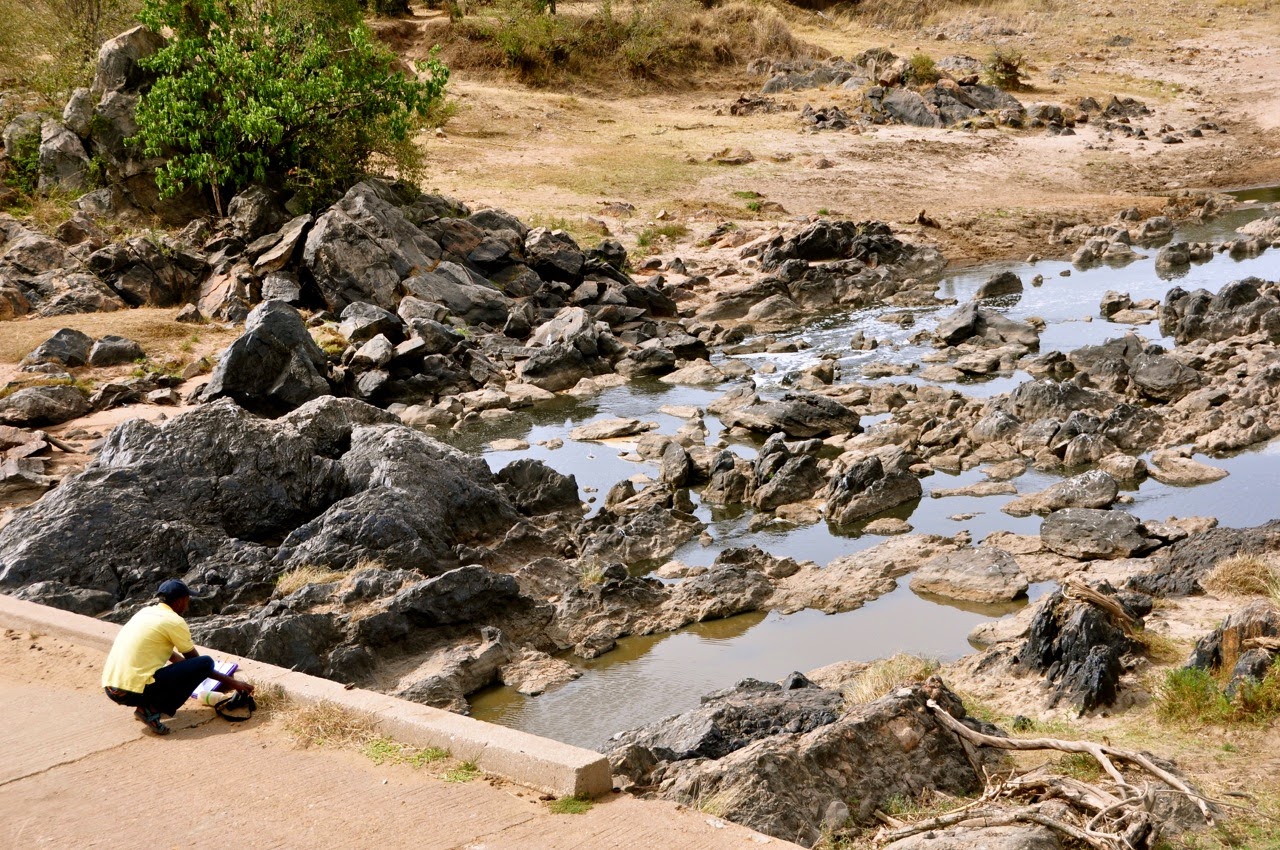
During the food web short course, we had several great scientists from the National Museums of Kenya join us, including Laban Njoroge, Head of the Invertebrate Zoology section and an expert in aquatic macroinvertebrates, and John Kochey, a scientist in the Invertebrate Zoology section and a doctoral student studying freshwater prawns. John brought along some prawn traps to set in the river, and at the New Mara Bridge, on the border of Kenya and Tanzania, we caught a crab! We have seen a similar type of crab in the upper Mara, but we have never seen these in the lower Mara, and it turns out this is the first time this species has been documented in the Mara. It is Potamonautes niloticus, which is found within the Nile Basin, including Lake Victoria and its tributaries. It's a beautiful animal, with an olive green back and bright red claws tinged with blue. It's so exciting, after all the time we have spent in the Mara, to still be finding new animals there, especially one as unique as this.
Wednesday, July 6, 2016
Monday, July 4, 2016
Food Web Short Course
This year we taught our first short course on food webs and stable isotope ecology in the Mara River. The course was taught by myself, David Post, Emma Rosi-Marshall and Frank Masese, with funding from the National Science Foundation. We had 12 participants from Yale University, the National Museums of Kenya, Egerton University and Eldoret University. Some of the course participants were senior scientists or professors interested in learning more about these topics, and others were undergraduate or graduate students still planning their research. The course began with a day of lectures, followed by three days of a field sampling campaign, and then a final day of data analysis.
It was a really wonderful group of scientists and colleagues, all of whom work on different areas of freshwater ecology, and we had a wonderful time together in the field! The best part about the course was that everyone had different areas of specialization, so we all learned from one another.
| Our outdoor laboratory |
| Searching for macroinvertebrates |
| Sorting bugs |
| Electroshocking for fish |
| Setting gillnets for fish |
| Streamside lecture |
| The requisite breakdown |
| Outdoor laboratory #2 |
| Electroshocking for fish |
| Picking bugs out of hippo poop |
| Sampling with an armed ranger |
| Collecting wildebeest bones to sample biofilm |
| Lecture on aquatic macroinvertebrates |
| The team |
Tuesday, June 21, 2016
Welcome to the Mara, James!
This summer we have two undergraduate students joining us in the Mara for the first time. They are part of a Research Experience for Undergraduates (REU) program through our National Science Foundation grant. The first student, James Landefeld, joined us in the Mara this week. James will be conducting research on the influence of hippo and wildebeest inputs on the Mara River food web, using both field sampling and artificial streams. Karibu James!
Friday, June 10, 2016
Bush baby
This summer we have a new field assistant joining us in the Mara... Lily will be coming along on her first field expedition! It will be a whole new adventure to have her in the Mara with us. I'm a little nervous (wildlife, malaria, equatorial sun, oh my!), but mostly excited! I hope she loves it as much as we do.
Monday, June 6, 2016
Invited lecture at the University of Antwerp
On our way to Kenya for our 2016 field season, we stopped by to visit our colleagues, Jonas Schoelynck and Eric Struyf, at the University of Antwerp. Jonas invited me to give a lecture at the Institute of Environment and Sustainable Development's Water in the World Series on the influence of large wildlife in the Mara River. It was a great honor and a lot of fun.
Jonas and Eric visited us in the Mara in 2014 to study the influence of hippos on silica cycling in the system, and we're now working together on a paper on this topic. It was a short stay (and a little unnerving to leave 7 bags of research gear in a coin operated locker at the airport), but we covered a lot of ground and had a great time!
| Jonas and Eric sampling silica in the Mara River |
Monday, May 23, 2016
Thursday, October 1, 2015
Huge wildebeest drowning in the Serengeti
Chris and I are currently back at Yale, but Geemi has been doing an outstanding job documenting wildebeest river crossings and drowning events this year in the Mara River. So far, there have been over 70 river crossings and just one drowning with 1,200 individuals. This is much fewer what we have documented over the past four years (an average of 5 drownings and ~7,000 individuals per year). All of our research thus far is on the Kenyan side of the border, but we just saw a report online of a huge wildebeest drowning that just happened on Sept. 29 in the Mara River on the Tanzanian side. From speaking with Mara Conservancy rangers, Geemi has learned the drowning happened fairly far downstream in the Serengeti, but we are still trying to find out more information. The original article was posted on Africa Geographic, and here's a photo from their story...
| Wildebeest drowning in Mara River, Serengeti (photo from Africa Geographic) |
Wednesday, August 12, 2015
ESA 2015
Amanda, Lily and I are at the Ecological Society of America meeting in Baltimore this year. Amanda co-hosted a session called "Danse Macabre: The Role of Migrations and Mortality in Shaping our Planet" and presented on the "Causes and consequences of wildebeest mass drownings in the Mara River, Kenya".
I gave a poster on "Tracking flood pulses and their impacts on water quality using a low-cost, open-source monitoring network in East Africa." Data from the network is available on Thingspeak. If you're interested in the base code that I use in the water level stations and the weather stations (take a measurement and then upload to Thingspeak via a GPRS connection), you can get it here - https://github.com/cldutton/MaMaSe.
Saturday, April 25, 2015
Geemi in Action
Some photos of Geemi documenting hippo aggregation numbers during extremely low flows (Thanks to Angela @ The Mara Conservancy for the photos!).
Friday, March 20, 2015
Non-seasonal wildebeest crossings and cholera outbreaks
A herd of zebra and wildebeest just crossed the Mara River, North of Serena. Geemi got a few good pictures of it. Here is one of them...
The Mara is amazing low right now. We estimate the flows at around 1 m3/s at Purungat Bridge (see here for the water level data). The zebra and wildebeest had no trouble crossing the river.
Unfortunately, the low flows are probably contributing to the cholera outbreak in the upper catchment. Read more here - Bomet hotels closed over cholera outbreak and here - Two die of Cholera in Bomet.
The Mara is amazing low right now. We estimate the flows at around 1 m3/s at Purungat Bridge (see here for the water level data). The zebra and wildebeest had no trouble crossing the river.
Unfortunately, the low flows are probably contributing to the cholera outbreak in the upper catchment. Read more here - Bomet hotels closed over cholera outbreak and here - Two die of Cholera in Bomet.
Subscribe to:
Posts (Atom)