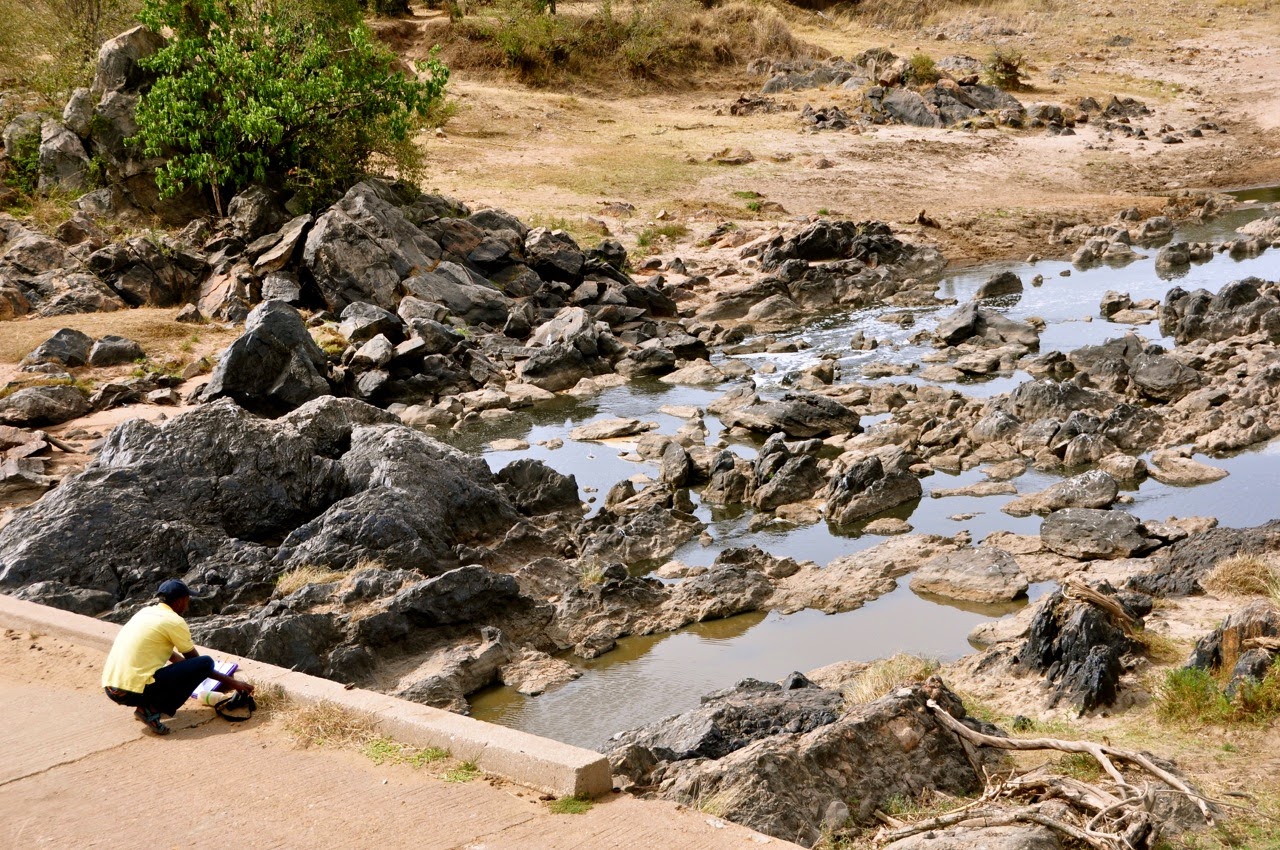
Some photos of Geemi documenting hippo aggregation numbers during extremely low flows (Thanks to Angela @ The Mara Conservancy for the photos!).
Saturday, April 25, 2015
Friday, March 20, 2015
Non-seasonal wildebeest crossings and cholera outbreaks
A herd of zebra and wildebeest just crossed the Mara River, North of Serena. Geemi got a few good pictures of it. Here is one of them...
The Mara is amazing low right now. We estimate the flows at around 1 m3/s at Purungat Bridge (see here for the water level data). The zebra and wildebeest had no trouble crossing the river.
Unfortunately, the low flows are probably contributing to the cholera outbreak in the upper catchment. Read more here - Bomet hotels closed over cholera outbreak and here - Two die of Cholera in Bomet.
The Mara is amazing low right now. We estimate the flows at around 1 m3/s at Purungat Bridge (see here for the water level data). The zebra and wildebeest had no trouble crossing the river.
Unfortunately, the low flows are probably contributing to the cholera outbreak in the upper catchment. Read more here - Bomet hotels closed over cholera outbreak and here - Two die of Cholera in Bomet.
Thursday, March 20, 2014
Logistics
So here's how Tuesday unfolded...
2:50 pm - Alternator bearing froze in the middle of the Mara. We had already been suspicious of the new sound coming from our engine, and a friend's mechanic had checked it out, diagnosed the problem, and determined we could safely drive the 2 hours to the nearest town. We broke down a few hundred meters later.
2:53 pm - We had already ordered a new bearing from Nairobi as soon as we heard the diagnosis. Determined we couldn't get the part from Nairobi until the next day. Called our mechanic in Narok, 2 hours away, to source a more local alternative.
3:07 pm - Called our field assistant in Mulot, 1 hour away, to look for a back-up option.
3:11 pm - Called our friend whose family owns a shop in Aitong, 30 minutes away, to look for a back-up, back-up option. The closer the towns, the smaller they were, and the less likely we could find the part we needed, but it was worth the try.
3:49 pm - Determined a used alternator from Narok was the best/only option. Sent all the money we could (not enough) via cell phone to our mechanic to purchase the alternator.
4:05 pm - Our mechanic left Narok on a motorbike with the used alternator, heading for the Mara. The roboticists and I went to hang out with our friends we had been visiting. Chris, like a true sea captain, wouldn't leave the vessel, and insisted on sitting outside the gates in the afternoon sun with the Land Rover.
6:49 pm - Our mechanic arrived at our Land Rover in the Mara. She (the Land Rover) and Chris are outside the gate, and it's starting to get dark.
7:30 pm - Chris rolled into our friend's place, new (used) alternator in place and the Land Rover purring like her normal self again. Decided it was too late to drive, and a great opportunity to spend more time catching up with friends, so set up our tents for the night.
4 hours and 40 minutes from breakdown to repair in the middle of the Mara-- not bad! Of course, we have some great friends to thank for their help in getting things running again so quickly, and having a comfortable place to camp for the night. In Kenya, logistics are all about who you know, and how easily you can contact them. I can't imagine having worked here before cell phones!
2:50 pm - Alternator bearing froze in the middle of the Mara. We had already been suspicious of the new sound coming from our engine, and a friend's mechanic had checked it out, diagnosed the problem, and determined we could safely drive the 2 hours to the nearest town. We broke down a few hundred meters later.
2:53 pm - We had already ordered a new bearing from Nairobi as soon as we heard the diagnosis. Determined we couldn't get the part from Nairobi until the next day. Called our mechanic in Narok, 2 hours away, to source a more local alternative.
3:07 pm - Called our field assistant in Mulot, 1 hour away, to look for a back-up option.
3:11 pm - Called our friend whose family owns a shop in Aitong, 30 minutes away, to look for a back-up, back-up option. The closer the towns, the smaller they were, and the less likely we could find the part we needed, but it was worth the try.
3:49 pm - Determined a used alternator from Narok was the best/only option. Sent all the money we could (not enough) via cell phone to our mechanic to purchase the alternator.
4:05 pm - Our mechanic left Narok on a motorbike with the used alternator, heading for the Mara. The roboticists and I went to hang out with our friends we had been visiting. Chris, like a true sea captain, wouldn't leave the vessel, and insisted on sitting outside the gates in the afternoon sun with the Land Rover.
6:49 pm - Our mechanic arrived at our Land Rover in the Mara. She (the Land Rover) and Chris are outside the gate, and it's starting to get dark.
7:30 pm - Chris rolled into our friend's place, new (used) alternator in place and the Land Rover purring like her normal self again. Decided it was too late to drive, and a great opportunity to spend more time catching up with friends, so set up our tents for the night.
4 hours and 40 minutes from breakdown to repair in the middle of the Mara-- not bad! Of course, we have some great friends to thank for their help in getting things running again so quickly, and having a comfortable place to camp for the night. In Kenya, logistics are all about who you know, and how easily you can contact them. I can't imagine having worked here before cell phones!
Tuesday, March 18, 2014
True safari experience
Wouldn't be a true safari experience without a breakdown! Alternator bearing froze approximately 500 meters after a mechanic told us we could make the 2 hour drive to town. Fortunately we're near some friends who can help out, and we're pulling out all our logistics tricks to sort this out... wonder where we'll end up tonight...
Friday, March 14, 2014
The Hippo Test
After our test run with the robotic boat the other day, we were feeling pretty confident the boats would be fine in the river... it was just the hippos we were nervous about. Hippos can be pretty territorial about their pools, even attacking one another and sometimes pushing subordinant males out of the pool completely, with plenty of deep scars to show for it. While hippo skin is tough enough to sustain the sharp tusks of their fellow pool-mates with usually minimal damage to the animal, we didn't think our boat could handle a bite. Our goal was to avoid a hippo interaction altogether, which we hoped the crocodile disguise would help with. Hippos and crocodiles share pools, albeit sometimes grudgingly, but all we needed was for a hippo to think twice before attacking the boat.
We went down to the water's edge and gently set our craft afloat. I could feel my stomach in my throat, watching this boat with all this important scientific equipment being sent out into such dangerous waters.
Of course, it wasn't just the boat that was in a precarious position. Going down to the water's edge at a hippo pool can be dangerous, due to both crocs and hippos, so we hired an armed ranger from the Mara Conservancy each day to accompany us. Still, it made me hyper-vigilant every time one of our guests approached the water, and I was constantly urging them to minimize their time at the water's edge.
The hippos were definitely curious about the boat, and they kept popping their heads above water and blowing forcefully out of their nostrils, as if issuing a warning to the "crocodile" not to get too close. Fortunately, the hippos also congregated closer and closer, allowing us to get a pretty thorough survey of the majority of the pool. We managed to get within a few meters of the hippos, but we decided not to push our luck any further.
It wasn't just the hippos that were curious-- we also had a vervet monkey climb out on a tree limb over the river in order to get a closer look at this strange creature!
Everything went remarkably well, and we surveyed hippo pool after hippo pool, increasingly confident in the boat's ability to deter the hippos, and our boat driver's ability to avoid the hippos. Of course, just when you're getting comfortable is when nature will choose to remind you who's really in charge. We were surveying the last hippo pool of the day, which was down inside a deeply incised river channel. The hippos at this pool seemed especially ornery, and we had to launch the boat about 100 meters downstream of the hippo pool in order to approach the river safely. It was difficult to walk down to the river and launch the boat, because the banks were so steep and the edge of the riverbank dropped off quickly. All of this contributed to a general sense of unease as we watched our pilot slowly navigate the boat upstream.
As the boat approached the pod of hippos, suddenly one huge male broke away from the pod and came lunging towards the boat. The pilot cranked up the speed on the boat, but the hippo kept gaining ground. We all watched breathlessly to see if the boat would be able to escape, and suddenly, something seemed to spook the hippo, and he made one last giant splashing lunge towards the boat and then turned around. The boat zoomed away, and the hippo grudgingly returned to his pod.
The video of this event is pretty exciting to watch, and it got a lot of coverage online. You can see a list of links to stories about our work and a video of the chase here.
Thursday, March 13, 2014
Wednesday, March 12, 2014
Can a robotic boat tell us what's at the bottom of a hippo pool?
What happens inside of a hippo pool? Is it deep with a hard bottom, because the hippos are always wallowing out the mud and sediment? Or is it shallow with a soft bottom, because there are lots of hippos defecting inside of it all the time? How do the pools compare to the river reaches up and downstream? Wouldn't you love to know what is happening at the bottom of a hippo pool? So would we! But it's hard to study a place you can't get into, and it's hard to get into a place inhabited by a number of 1,500 kg animals widely considered to be the most dangerous animal in Africa.
The first day they were here, we took the boats out for a test run on a stretch of river without any hippos. The boat looked great and worked well, but the real question is, will it survive encounters with hippos and crocodiles?
I have to admit, I have no idea if this will work, and I'm both nervous and excited about it. If all their boats get eaten right away, this will be a long and awkward two weeks together. But if they work, we're going to discover some of the hidden secrets of the bottom of the Mara River, and gain invaluable knowledge about how hippos influence river ecosystems. Fingers crossed for the latter!
We posed this problem to a group of robotics engineers from Carnegie Mellon University who have started an innovative company called Platypus. They design robotic boats that can autonomously create detailed spatiotemporal maps of water quality parameters. There are lots of uses for these boats, such as sampling in otherwise difficult-to-sample areas. Well, we have some difficult-to-sample areas!
After lots of discussions, the folks from Platypus agreed to come to the Mara to spend two weeks with us in the field, using some of their robotic boats to map the insides and bottoms of hippo pools in the river. We warned them that some of their boats may not survive the trip, but they were up for the challenge!
| John and Chris from Platypus rigging up their robotic boat |
To help the odds of boat survival, on the advice of a Maasai fellow, they decided to disguise the boat as a crocodile. They found this amazing foam croc head, which we attached to the front of the boat, and we covered the body of the boat with a camouflaged tarp. Other than the depth sensor and camera mounted on the back, it looked pretty convincing cruising through the water!
| Robotic crocodile cruising the Mara |
| Deploying the boat for a test run |
Saturday, March 8, 2014
Closing the streams
After about a month of running our experimental streams, it was time to finish out the experiment. The main thing we wanted to measure was how much biofilm and of what different types grew in the streams under different treatments. Biofilms are groups of microorganisms which grow on a surface. We usually think of biofilms as being comprised of algae, but they can also have a lot of bacteria in them as well.
I have to admit, I was a little worried nothing would grow, which would make it difficult to measure any effects of the treatments. Fortunately, that was an unnecessary fear! After 4 weeks of running, it was incredible how much biofilm our streams had grown! You could clearly see it on both the tiles and gravel we had placed in all the streams.
A lot of the biofilms were green and looked like algae, like this rock below, but we took measurements that will help us determine the quantity and composition of the biofilms in each stream.
We will have to analyze all our samples and run statistical tests on the data before we will know if the experiment "worked" scientifically speaking-- that is, did the treatments have significantly different effects on biofilm development that we could measure? However, after running smoothly for one month and growing lots of great biofilms, I can happily say the experiment was a success! When we started this process, we didn't even know if we could get these things to hold water, much less act like small streams. Truly, we owe all the success of this experiment to Paul Geemi, our tireless field assistant.
Geemi camped next to the streams for one and half months, just to help maintain them and keep them running. He changed out 50% of the water in each stream every day-- that's a lot of pumping water and filling and carrying buckets! He monitored the power that kept the paddlewheels turning and switched things over to battery when there were power outages, even in the middle of the night. He also did a great job doing outreach and education for the many people who came by and wanted to learn about the experiment. And through it all, he kept the most thorough and well-written field notes I have ever seen!
Field biology is full of unsung heroes-- the people actually out there in the heat and the rain and the dark, doing the work, carrying the heavy weight, monitoring the results, keeping things working. Often times, these are not the same people who end up analyzing and writing up the data, so they don't always get a lot of credit for the work they do. Geemi is definitely the reason these streams worked as well as they did (or even at all!), and we are super grateful to be able to work with him. Thanks Geemi!
| Biofilm growth in tiles in the streams |
| Biofilm growth on rocks in the streams |
| A rock covered with algae |
| Geemi changing water in the streams |
| Geemi doing outreach about the streams |
| Geemi, the unsung hero of the experimental streams |
It all comes back to silica
After Emma and David left, we hosted two colleagues from Antwerp University, Belgium, in the Mara. Jonas Schoelynck and Eric Struyf study silica cycling and are particularly interested in the role animals might play in the silica cycle.
What is silica? It's commonly found in nature as quartz, but it can also be found in living organisms like grass (it gives grass the sharpness that can cut you). Silica is taken up by diatoms in the ocean, that are at the base of the food web, and it is often limiting to their growth. That it, the more silica there is, the more diatoms there are, and the more overall productivity in that region of the ocean. A lot of the silica in the ocean is brought in by rivers, and it has generally been assumed that all of that silica originated from weathering of rocks. But recent advances in the last decade have shown that animals can actually contribute a great deal of silica by eating grass and defecating it out, and the silica defecated by animals is more reactive than that simply eroded form rocks. If it involves animals eating and defecating grass, we have the perfect animal to study...
| Hippos basking in the Mara River |
Jonas and Eric came to the Mara to work with us to investigate the role hippos might be playing in the silica cycle. To study this, they collected water and sediment samples from multiple reaches of the river with varying densities of hippos.
| Eric collecting a pore water sample from the Mara |
| Jonas and Eric collecting a sediment core from the riverbank |
| Jonas and Eric on the banks of the Mara |
They also took sediment samples in the middle of the grasslands for comparison.
| Jonas and Eric collecting a sediment core in the savanna |
Friday, March 7, 2014
If optical brighteners are in the Talek, shouldn't the water be "whiter and brighter"?
After spending two great weeks with us, David had to return to the US, but we had one more week in the field with Emma. During this time, we spent some more time investigating the Talek River and its tributaries. A lot of Emma's research is focused on understanding the impact of humans on river ecosystems, and she is working with us to untangle the role of urban developments vs. tourism facilities vs. hippo inputs in the Talek River and its tributaries. This is an important river system to understand because it is the main tributary in the middle reaches of the Mara, and it enters the Mara River in the middle of the reserve. However, water quality in the Talek can be very poor, which may have a big impact on the water quality we see in the downstream portion of the Mara.
| Build-up of rotting hippo feces and in a tributary of the Talek |
As one tool in our toolbox, we worked on a new method that can be used to detect something called "optical brighteners" in river water. I had never heard of optical brighteners until recently, but they are in many kinds of laundry detergent, and are what make your clothes look "whiter and brighter." It's not that optical brighteners are necessarily bad for the river, but if they are detectable in a river, they indicate the presence of large human inputs of other kinds, like nutrients and sewage.
| Emma and Chris collecting water samples in the Ntiaktiak River |
Sure enough, we did find optical brighteners present at certain sites in the river, but not necessarily where we expected them. This is an exciting new tool to have, but as usual with new methods, it only raised more questions for us.
| Emma testing for optical brighteners |
| Collecting hippo feces from hippo pool surveys |
| Amanda and Emma at the Mara Serena airstrip |
Subscribe to:
Posts (Atom)