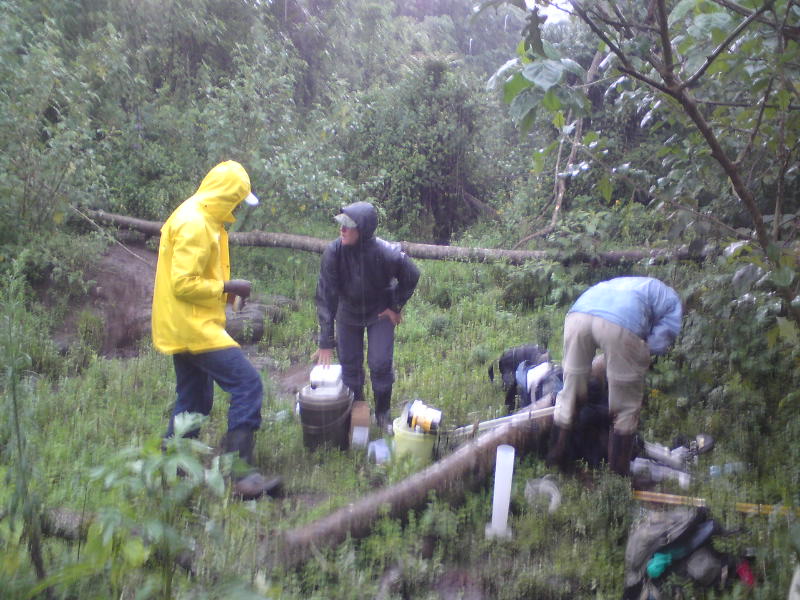
Last week while we were in Nairobi taking the Graduate Record Exam - GRE (shameless plug - we are in need of funding to pursue further graduate studies, if you know of any options, please let us know), we were notified of a mass fish die-off in the Mara River. Apparently, many large fish from multiple species showed up dead on the bank of the river after the first large storm of the season. The die-off seemed to be localized just north of the New Mara Bridge, just upstream of Tanzania.


At the time we were notified, one of the suspicions was that it was related to fertilizer runoff that migrated into the river during the heavy rain. Many farmers upstream had just sprayed their crops and the speculation was that this fertilizer run-off "poisoned" the fish. We were a bit hesitant to pin it on any one cause without first taking some samples and seeing the situation.
In the past, there have been previous mass fish die-offs in this area. They always seem to occur immediately after the first long rains at the end of several months of drought. The water level in the river is very low and the first heavy rain storm will cause a large amount of sediment, plant debris, animal fecal matter and "garbage" from the river's catchment to go rushing into the river. The river will rise rapidly as it is all the sudden carrying all of this extra material downstream towards Tanzania. The
salinity will rise, the
dissolved oxygen will drop and the water will become extremely
turbid.
Once we finished the GRE in Nairobi, we took off for the Mara River to do some sampling. As most of you know, we have spent the last year collecting a huge amount of information on the
Benthic Macroinvertebrate community within the Mara River. We figured we could use our dataset from this last year to help determine what happened in the Mara River a few days prior. How are we going to do that? Well...since we know what bugs are supposed to be in the river during healthy flows...and by sampling for the bugs in the same manner we did this last year...we can determine which species are not present in the river. This will give us a pretty good idea as to what may have happened or what could NOT have happened. A bit of a drastic example is that if a massive chemical spill...think
Exxon Valdez...swept through the river and killed all the fish, we won't find any bugs in the river...right? Because that same massive chemical spill would have also killed all the bugs as well.
We can take our dataset of the bugs of the Mara and compare that to a sample taken three days after the mass fish die-offs and correlate that to the
United States Environmental Protection Agency's Macroinvertebrate Field and Laboratory Methods for Evaluating the Biological Integrity of Surface Waters which lists the pollution tolerances of select macroinvertebrates. By determining which species we are missing from a healthy flowing Mara, we may be able to get an idea of what may have happened. We can then check out the Quick Inventory of Chemicals used in Farm and Mining Activities within the Mara River Basin to see what possible fertilizer type chemicals could have been swept into the river.
During our sampling three days after the fish die-off, we found some healthy macroinvertebrates such as this one...

This leads us to believe it wasn't a catastrophic type of event. In fact, we have seen this happen several times over the last 2 years. We speculate it may be related to the quick change of the environment within the river that makes it a less favorable to certain species. Four days after the mass fish die-offs, we were able to document a dramatic rise in turbidity and salinity during a similar heavy rain storm. The below chart captures the temperature (degrees Celsius) and salinity (ppt) changes in the Mara River over almost 48 hours. It also captures two large rain events. The first rain event caused a noticeable drop in temperature and the second rain event cause a dramatic rise in salinity.

Unfortunately, we weren't able to get dissolved oxygen readings because the water was so turbid and quick, our dissolved oxygen membrane was damaged. No worries, we have already fitted our spare membrane for next time. We documented the turbidity as high as 1,300 NTUs but it probably got much higher during the surges. Check out
this page for a good explanation of turbidity and how it can effect fish.
The rangers working at the New Mara Bridge know that these mass fish die-offs are somewhat common. They have seen them occur every year at the beginning of the rains. We have seen them occur several times as well. One possibility is that the die-offs are tied to the rapid rise in sedimentation, salinity, turbidity, and the drop in dissolved oxygen caused by the massive amount of sediment, plant debris, animal fecal matter and "garbage" being swept into the Mara River during the first rains. Just imagine how much fecal matter 1,000,000 wildebeest deposit on the plains during the migration that then get rapidly swept into the river during the first major rains. Would you want to swim in that?